If your Saab 9-3 NG refuses to start or no longer recognizes your keys, the CIM (Column Integration Module) is often the primary suspect.
However, there is a common trap: blaming the CIM too quickly. On these architectures, a network anomaly, power issue, or configuration error can perfectly mimic a "module failure."
The CIM: A Gateway for the Whole Car
On the 9-3 NG, the CIM doesn't just house the steering wheel controls. In the workshop documentation (WIS), it acts as a gateway between the P-bus (Powertrain) and the I-bus (Instrumentation/Cabin).
In other words: it relays information between networks that speak at different speeds. For example, certain engine data (P-bus) is transmitted to the instrument cluster (I-bus) via the CIM.
Why symptoms can be "random"
Networks are about interdependence:
- If a bus is unstable, multiple modules can go into fault mode.
- If the key/gateway communication fails, the symptom looks like a "mechanical" start failure, while the cause is logical/electronic.
- If a configuration is incomplete, some systems may drop out while others operate in a degraded state.
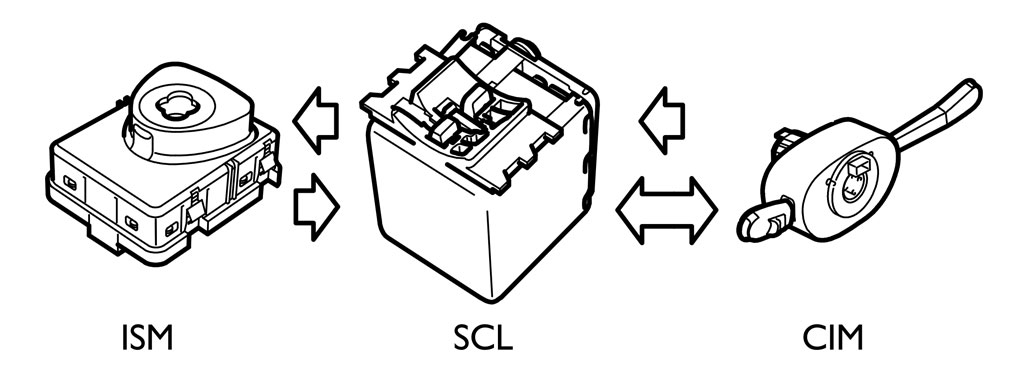
Before replacing, you need a methodical diagnostic approach. This schematic shows the critical relationship between access modules:
Diagnostic Method (No Guessing)
I recommend a three-tier logic:
1) Simple Prerequisites
- Battery voltage and drops during cranking.
- Network power and grounds.
- Visual check of connectors (corrosion, moisture).
2) Network State and Consistency
Using a proper tool (Tech2/MDI), look for:
- Communication consistency (presence/absence of modules).
- Intermittent network faults.
- Correlation between symptoms and events.
3) Validation
Even when a CIM is suspect, the goal is to validate it—either in the car or on a test bench when relevant.
The Bench Test: Simulating Reality
To ensure reliable interventions, a test bench allows us to simulate real-world conditions. On a Saab, this often includes the O-bus (fiber optics) to validate infotainment consistency. The O-bus is an optical ring: if the ring is open, the chain won't validate correctly.
This is critical: Saab documentation reminds us that communication with the CIM is a prerequisite for the diagnostic tool to speak properly with all other systems.
Refurbishment: Staying Factual
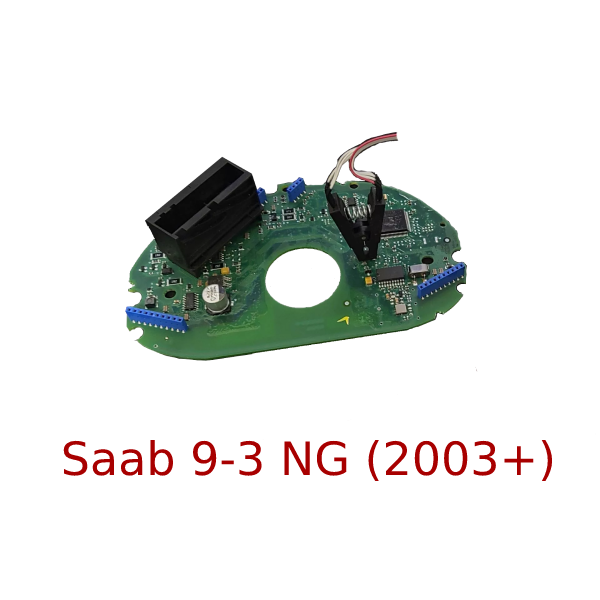
In reality, a module can be replaced and configured, repaired, or replaced by a compatible used part. This PCB view highlights the complexity of the unit:
For "Keys/Access" topics, I apply a strict framework: Proof of ownership and legitimate intervention only. The goal is preservation, not bypassing security.
"The CIM isn't a 'magic part'. It's a crossroads. When you understand what it connects, you diagnose faster—and replace less."
References and technical validation:
- CIM = gateway between P‑bus and I‑bus + speeds 500 kbps / 33 kbps (WIS).
- O‑bus: optical, audio usage (WIS) + 25 Mbit/s optical ring (Saab doc).
- O-bus diagnosis: "communication with CIM is necessary..." (WIS).